
LIVE COACHING replay
With Olivia Fox Cabane
Presence, Power, Warmth, and Authenticity
Olivia Fox Cabane is a bestselling author, leadership expert, and the founder of KindEarth.Tech, where she helps leaders and organizations develop the skills to thrive through influence, connection, and innovation. Best known for The Charisma Myth, she has taught leadership at Stanford's StartX accelerator and has advised executives, entrepreneurs, and Fortune 500 companies around the world.
The through-line of Olivia's career has been a commitment to making exceptional leadership skills accessible to everyone. She now teaches leaders how to cultivate authentic presence, strengthen relationships, and create meaningful impact through evidence-based practices.
Learn more at oliviafoxcabane.com
Chapters
- Welcome + Introduction(00:00:00)
- The Evolving Science of Charisma(00:00:49)
- Charisma, Authenticity, Intent, and Impact(00:10:36)
- Body Language, Self-Acceptance, and Meditation(00:16:20)
- Training Presence and Vocal Charisma(00:27:01)
- Self-Forgiveness and Cognitive Reappraisal(00:34:58)
- Helping Kids Build a Strong Sense of Self(00:39:47)
- Measuring Impact + Closing Reflections(00:44:13)
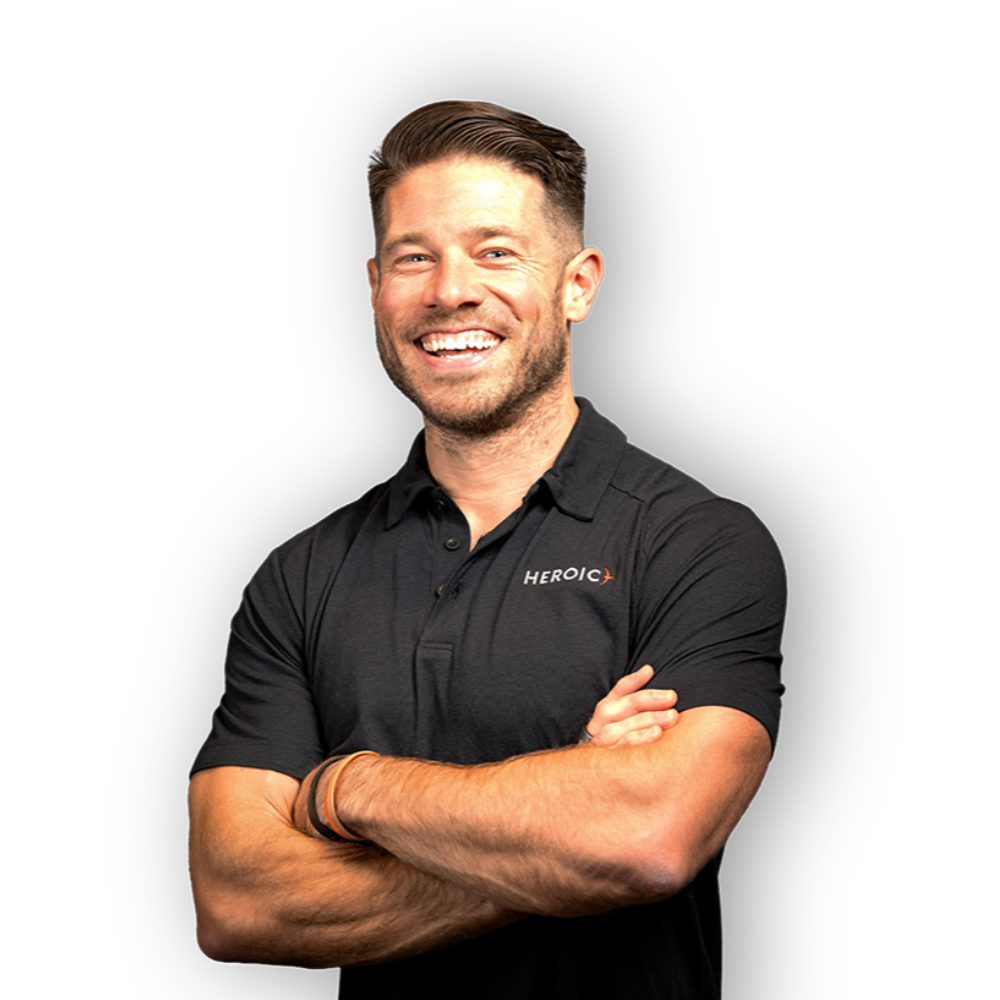
Meet Michael our Head Coach and CEO
Fifteen years of practice, not theory.
Michael Balchan has practiced and applied the Heroic framework every day for fifteen years, working alongside founder Brian Johnson through every program Heroic has built.
He is a Harvard-trained behavioral economist and performance coach who has helped thousands of individuals and organizations operationalize the Heroic framework. He blends cutting-edge psychology with timeless principles of human flourishing, equipping leaders and coaches with tools to create meaningful, lasting impact.
Ready to Start Your Heroic Journey?
Start with Philosopher's Notes and Discover the #1 Thing That Will Most Change Your Life Right Now
Take the FREE, 60-second assessment to discover where a little more wisdom, discipline, love, or courage will make the biggest difference in your life right now.
Find Your #1 Thing
Full Transcript
Michael Balchan 00:00
Olivia, welcome. Fired up to connect. The book's been out. Author of The Charisma Myth and The Net and the Butterfly. The original Charisma Myth, 2013. Is that right?
Olivia Fox Cabane 00:11
The original edition, yes. The new edition came out in the U.S. in February and came out internationally a couple weeks ago.
Michael Balchan 00:18
Beautiful. Congrats on revisiting it. It's been foundational for us for so long. When you reached out and said, "Hey, we've got the new edition up," we were excited to chat about it. We're so looking forward to connecting because it's had such a big impact on me, but also on our coaches. Presence, power, and warmth are so central to not just charisma, but relationships in general. So, really looking forward to connecting.
Olivia Fox Cabane 00:45
It's great. I'm delighted to be here, and look forward to the questions.
Michael Balchan 00:49
Let's start. Why charisma? What was it that originally interested you in charisma?
Olivia Fox Cabane 00:57
So, I'm autistic, and growing up, it was always clear that most of the other humans seemed to have a manual on how to be a normal human that I hadn't gotten.
And around age 18, I realized that I really had kind of two paths: either exile myself to a desert island, which believe me is still an attractive option on occasion, or learn how to make the whole human thing work, and in learning how to interact with humans, I figured if I'm going to learn, I might as well learn how to interact as best as possible, and that's when I gradually came to realize that charisma, which I had always thought to be some magical innate quality, was actually a science that had just started to come out because this was around 2009, and the big studies were just starting to come out.
So it was a fascinating time.
Michael Balchan 01:56
And then why revisit it now?
Olivia Fox Cabane 01:59
So the honest answer is that people kept buying the damn thing, and it was physically painful for me to know that people were buying something where the science was outdated.
So, because it's been 15 years, the science has moved on, and so first I wanted to update the science, but second, the world has moved online, and one of the most fascinating developments in charisma science has been the science of online charisma, which is its own branch with its own experts, with fascinating findings. And so, I wanted to include online charisma and neurodivergent charisma, since I had made certain decisions in the intervening years as to whether or not to practice charisma.
Frankly, because I had learned more about autistic masking and the cost of it, the toll it takes on autistic people. So there were just a lot of new things to develop, and so the deal I made with Penguin was: sure, I'll write your next book, but let me update this one first. So here we are.
Michael Balchan 03:06
So let's walk through some of the changes. Then the science has changed, right? Online charisma and then neurodivergent charisma, and just the honoring of who we are and our essence, no matter what those inborn qualities are. But simultaneously, I would guess learning from some of these foundational pieces for how to actually bring that forward.
Olivia Fox Cabane 03:26
Yeah, it's really been fascinating looking at the online charisma part, for example. In charisma, I had some preconceptions, for example, that lower voices are more charismatic. That science just proved plain wrong.
Steve Jobs is one of the most charismatic voices that had been studied, and his voice is so high it occasionally goes into the female register, but he hits all of the charismatic markers, and so that's why he tends to rate at, in one study, 97% where Mark Zuckerberg tops out at about 53, but there were other findings where the larger your face is on screen, the more likable you will appear.
And here, I'm always going to prefer giving the bad news rather than pretending it doesn't exist: audio compression leads to emotional confusion, where, for example, emotions like excitement and enthusiasm get misheard as impatience and anger, especially for women.
Michael Balchan 04:44
Sonia, I see you moving.
Sonia | Team heroic 04:46
No, she's frozen. Oh, yeah.
Michael Balchan 04:50
Yeah, beautiful. We'll take a moment to breathe and practice our presence. One of the things I'm excited to circle back on later is presence practices.
Olivia Fox Cabane 05:24
So sorry about that. It looks like I just dropped out.
Michael Balchan 05:27
Welcome back.
Olivia Fox Cabane 05:28
Thank you. What's the last you heard?
Michael Balchan 05:33
You were saying that audio compression mixes up excitement with anger or anxiety, especially higher in the female register.
Olivia Fox Cabane 05:43
Yeah. So that's one of the things where, unfortunately, there is a clear gender difference, and there's been so much work on charisma in the past 15 years. It's been really interesting seeing where gender differences play a part. So in clothing they play a part, in titles they play a part. So all of that I wanted to include in the new edition.
Michael Balchan 06:10
Yeah. What are some of those differences?
Olivia Fox Cabane 06:14
A male startup founder, for example, can show up in, I'm stereotyping here, an old hoodie and ripped jeans. To get the same level of respect that he gets automatically, a woman will have to dress a lot more formally.
So, unfortunately, the harsh truth is that increased formality of clothing and the titles with which a female founder is introduced make a big difference, but on the other hand, good news is you don't have to lower your pitch contrary to what a lot of us believed. So hey, there's some positive news in there.
Michael Balchan 06:52
So, are they still mapping onto presence, power, and warmth, and perceptions of power, etc.?
Olivia Fox Cabane 07:05
Yeah, that's the good news. So I was really expecting there to be a lot of pushback against the model, and instead, the model has been confirmed. And not only that, but there's one team that started testing out the presence, power, and warmth model to see if they could teach AIs how to be charismatic. So I don't know how solid the outcome of that is, but they certainly tried. So yeah, it's been fairly well confirmed. Now different studies call it different things.
Power is sometimes called dominance, sometimes it's called assertiveness, but broadly it's power. Warmth is sometimes called friendliness. Sometimes it's called receptivity. But you can all put that under warmth. Some of the interesting findings involved how to get the greatest amount of warmth online. Obviously, having the camera positioned at eye level or slightly above is one of the key things. But beyond that, taping the photo of someone that you really like, whether they're your best friend or Captain America, it doesn't matter.
What apparently matters more is the emotional reaction that you get, and speaking to that photo can be one of the ways of getting a boost in warmth. Some of the other findings that were fascinating were, of course, the cross-cultural findings.
So, vocal fluctuation was able to predict the outcome of Chinese public speaking contests, and on the other hand, the way that charisma was being demonstrated in Singapore when pitching a similar kind of startup needed to be completely different from how it was in Silicon Valley. So the cultural aspect has been fascinating.
I now work a lot more in the Middle East, and so of course, you can imagine I've had to adapt a lot of my advice because handshakes aren't going to be done the same way if you're in Asia. Eye contact is not going to be the same. So the cultural differences have been one of the most fascinating findings, really, of updating the book.
Michael Balchan 09:19
And that's the cultural difference in how presence, power, and warmth, or however they're being described in language, are communicated, recognized, and respected. What are the different ways in which we indicate those pieces?
Olivia Fox Cabane 09:32
Yeah. If you look at the Singapore example, it turns out that social sensitivity, so I guess you could frame that under the presence component, the ability to understand the social nuances, was in fact a much greater predictor of leadership success compared to assertiveness and confidence in the U.S. And listen, assertiveness and confidence have all sorts of advantages, but they certainly have downsides. And there are real risks that the classic overconfident, slightly arrogant, cocky founder gets funded when they shouldn't.
We all know people who are promoted past the level of their competence because they sound good and they sound like they know what they're doing, so the classic American charisma model absolutely has its limits. So do most of the other models, but it's just been fascinating to learn about how the different elements manifest.
Michael Balchan 10:36
And how about charisma and authenticity? I know one of the things Brian features in The Charisma Myth is that we want to recognize when we're uncomfortable, but still potentially use a tool or practice being open as we're leaning into more presence, power, and warmth. But then there's also recognizing who we are. It shows up in different cultures, neurodivergence, and all those kinds of things.
How do you think about charisma and authenticity, and how have your views evolved over the last 15 years?
Olivia Fox Cabane 11:10
There's been a lot of change. If you look at how I practice charisma these days, it's wildly different from how it was 15 years ago. I'm no longer optimizing for just maximum charisma, in large part because I've learned more about how heavy a lift it is for autistic minds, and I felt it myself, and how exhausting it can be. So, in a sense, personally, I've chosen to keep the charisma switch off most of the time.
If you want to see me at my most charismatic, it's not Bill Clinton level. This is just the maximum level I can get to. There are plenty of videos online from when I was code-switching to neurotypical, if you will. These days, frankly, I just don't have that much to prove anymore, and for me, it's not worth the cost.
But the fundamental view I have of charisma and authenticity these days is, as the book explained right from the start, there are as many different kinds of charisma as there are different kinds of people, and really, the most important question is for you to find the kind of charisma that fits your personality, your neurotype, and the situation as well as your goals. So you wouldn't want to use authority charisma if you're trying to comfort someone or to console them.
In the same way, kindness charisma is not what you're going to use if you need to get people out of a burning building. So it's really finding what will be most effective for that specific situation.
Michael Balchan 12:49
I love that. It's also dependent on the situation, on you, and on what you want to accomplish. And then those dials, turn them up, turn them down. They're still there and just as powerful. But there are those trade-offs of, well, there's an energetic cost for me in turning up those dials if I'm trying to do a certain kind of thing, and that's not a trade-off I want to make in a lot of situations.
Everyone is going to have their own version of that, but it's really dialing into what feels right. We had a recent conversation with Michael Neill. He's an old-school coaching expert who has trained a lot of coaches. I was going, "Hey, dude, give me the top guidelines for coaches." Rule number one was, "There is no way. There's only what's the right way for you, and how do you want to show up?" So, know these different tools, dials, and components, but really come back to what's right for you in that situation, with who you are and what you want to accomplish.
Olivia Fox Cabane 13:53
Yeah, you start with that, and you keep in mind the guardrails of intent and impact, which for me are really the two most important guidelines when using charisma, and you can't go far wrong. If your intent is good and your impact is good, use every tool at your disposal.
Michael Balchan 14:10
Can you tell us more about intent and impact?
Olivia Fox Cabane 14:13
It's what I answer when I inevitably get the question about charisma as manipulation, because that is an understandable worry that people have, and from my perspective, any time you are trying to change the inside of someone else's head, that is a manipulation. We are manipulating each other all the time.
Any time you are trying to influence someone to a different point of view, you are trying to change the way they are thinking, so that's why, for me, intent and impact matter more than whether you view this as persuasion. What are the limits between persuasion and manipulation? Intent and impact. Those are the limits I see. Everyone has a different perspective, but for me, those are the ones.
Michael Balchan 15:04
And what's the connection between those and warmth? In some ways, it's warmth as manipulation versus warmth as genuine goodwill and interest in the other person, right?
Olivia Fox Cabane 15:15
Yeah. So it really depends on: Are you using warmth? What's your intent? Are you using warmth to make the other person's life better? Are you using warmth to sell something? Are you using warmth to create a bond between you? And if yes, for what? And that's why impact is the second wing of this because intent is not enough. You can have the best intentions in the world, and if you have a horrible impact, stop doing the thing you're doing.
Michael Balchan 15:42
It's a good plan. I'm thinking about it. I've got two young daughters, five and eight, and thinking through intent and impact for their behaviors is a great framework. They're learning how to turn dials up and down. How do they want to show up in the world? I'd like to dig into body language a little more. I know that's something that's had different perspectives and gone in and out of favor in different ways over time.
How do you think about body language currently?
Olivia Fox Cabane 16:20
Yeah. So if you're talking about the replication crisis in psychology, Amy Cuddy's work, right? That's one of the things I most wanted us to get right. Where are we with power posing? Does it work? Does it not? What impact does it have? Listen, as far as Jordan...
Michael Balchan 16:34
Peterson's all lobster, right? Rule number one.
Olivia Fox Cabane 16:40
So as far as I understand from the latest, because Amy Cuddy came back in 2018 and said, "Yes, I did replicate it, and here you go." So, we had to take the neurotransmitter piece out, raise this hormone by 19 percent, raise that hormone by 25%. That was not replicable. However, did your body language affect your own internal emotions? Yes.
So there's still a strong argument to make that adopting specific postures will change your internal emotional state, your emotions, even if it's not measurable in neurotransmitters. That in turn does affect your body language, and so the virtuous cycle can still build on itself. We're good on that one. Does body language still have a far greater impact on interactions than words? Yes, the MIT Media Lab's work holds up. Sandy Pentland's work still holds up, so that's good.
Move away from the Albert Mehrabian study, because we have enough studies to have confirmed that you really should pay attention to your body language. It's just that now it has been so well studied that it branches out. So the scientific editor for the new edition of the Charisma Myth was this brilliant researcher called Oliver Niebuhr, who specializes in specifically vocal and digital charisma.
He is the expert on what a charismatic voice sounds like, and so there's enough of a body of work to study just charismatic voices, which, as you can imagine, what with podcasts and social media is actually more important now than it ever was before. We think that we're all image-based, but actually, because it's online, we lose a lot of the microexpressions, and so the voice becomes twice as important. So, as far as body language goes, still really important.
Power posing has been partially confirmed, and your voice turns out to be even more important than we thought.
Michael Balchan 18:41
We'll go to voice. I do want to learn more about how to create a charismatic voice or modulate the voice, right? But I want to circle back to body language and relationships, and your body language impacting other people. There are different ways to adjust body language: mirroring folks, similarity, or something else that I would guess has a very high degree of social variability, depending on where you are, proximity, personal space, and all those kinds of things.
How do you think about body language as a vehicle for communication? What suggestions do you have for folks looking to create a space of mutual safety, trust, and understanding?
Olivia Fox Cabane 19:27
So, I wish I had a different answer, but it really is a question of self-acceptance. The ability to know yourself, be comfortable with yourself, and therefore be able to stay present with yourself in the situation, is one of the key fundamentals in managing your own internal emotional state, from which all your body language emanates. The assertion that whatever your mind believes your body manifests still holds true, and so the real work of body language begins in the mind.
That means being able to get into the right mental state is far more important than knowing whether you should lift this quirk of an eyebrow because it's going to have this effect on the human psyche. And for that, I wish I had more original answers. But therapy and meditation. Those are really the two big tools for self-knowledge, self-acceptance, and comfort with the present moment.
Michael Balchan 20:43
Therapy and meditation. The body starts in the mind, so how can we have that degree of self-acceptance? It's that simple and that complicated, right? That's challenging for us.
Olivia Fox Cabane 20:55
It's simple, not easy. Sitting for three minutes, 20 minutes, or three hours is simple. It's not easy. Going on a silent meditation retreat is fairly simple, not easy.
Michael Balchan 21:09
Is meditation part of your daily practice?
Olivia Fox Cabane 21:14
It is. I've cycled through various forms of meditation. I really look at meditation as a toolkit, and in the same way you wouldn't use a hammer or a screwdriver for the same purpose, you bloody well shouldn't use metta or vipassana for the same purpose. They have different purposes, so it really is a question of what am I presently working on more? Am I working more on warmth? Am I working more on presence?
Is it just general mental health, and what am I hoping to get out of this? So, like many autistic people, I am very comfortable in the nice, dry cognitive realms of the mind. So, vipassana is by far the easiest meditation for me. Metta, which is the messy, awkward, uncomfortable work of the heart, is much harder.
But at the same time, it often has greater rewards, at least for me, than my comfort zone does, and that's going to be the case for a lot of the charisma tools. The ones that are in your comfort zone are not going to be the ones that get you the most rewards. They're just the easiest to start with.
Michael Balchan 22:21
I don't expect this to have a good, clean answer, but of all the tools you've tried over the last decades, whether self-acceptance tools or therapy and meditation as these two pillars, has there been a particular framework, question, pointer, or exercise that really helped unlock some of this self-acceptance?
Olivia Fox Cabane 22:48
Yeah, so CBT, cognitive behavioral therapy, was incredibly useful in my early 20s, and it's still the basis for a lot of modern therapy. But I found ACT, Acceptance and Commitment Therapy, to be more useful. CBT has some great advantages in that it teaches you to detach from unhelpful mental models, and that's great.
But where CBT gets you into trouble is that CBT then often asks you to argue back with your mind, and the problem, called the yellow Jeep or white bear problem, is that whatever you focus on, if I tell you whatever you do, don't think of a white bear right now. No, in fact, no bears at all. The first thing your brain thinks of is a white bear. Whatever you focus on is what your mind will be filled with.
So if you're struggling with self-criticism, arguing back against the self-criticism is not necessarily helpful. ACT, Acceptance and Commitment Therapy, has the added advantage of not getting you into a tug of war with your own mind. There's a whole alphabet soup. There's MBCT. There are all sorts of other ones.
A slightly less frequent form of therapy that can produce some fascinating results, but sometimes, wow, it's weird, is voice dialog, and in fact, the best book I know on handling the inner critic is called Embracing Your Inner Critic by Hal and Sidra Stone, and that is a voice dialog book. That form of therapy essentially says: listen, we all have voices in our head. We all have different voices in our heads, different sides of our personality that take over.
Instead of trying to repress them, pretend they're not there, or deal with them in your subconscious, you might as well give them some time to air their grievances, their wishes, etc. And so, voice dialog literally has you bring out the various voices in your head, so they can speak for themselves, and it can get to some pretty freaky but fascinating stuff that will come out of your mouth that you had no idea was there. So that's been another interesting one.
Michael Balchan 25:03
Vocalization is important in that, not just writing or thinking?
Olivia Fox Cabane 25:07
No, the therapist will have you move from chair to chair, or chair to couch, or wherever you are, and you will let different sides of your personality come out. So that's another fascinating thing to look at.
Then, in terms of meditation, all the meditations in motion, the walking meditations, the dancing meditations, ecstatic dance, 5Rhythms, EMDR, the meditations that do not rely primarily on a mental framework, are something that we tend to overlook because they don't have the same prestige as CBT or, God forbid, psychoanalysis.
Michael Balchan 25:57
I haven't heard of dancing as meditation. Dancing is like a state shift and joyful piece, but just the level of presence with the music and the movement and a release and surrender.
Olivia Fox Cabane 26:08
Yeah, literally, it's not...
Michael Balchan 26:09
Like you put your left hand in, your left hand out?
Olivia Fox Cabane 26:14
5Rhythms is probably the best known version of this. Gabrielle Roth, I think, was the creator, and she had her students move through different emotions in dance and different frequencies of music that were chosen, and there were exercises in the dance. But in a sense, Tai Chi is meditation in motion. A lot of traditional martial arts and any practice, I mean, bonsai curation is meditation in motion. It really is.
There's a reason that on silent retreats you'll be alternating sit, walk, sit, walk, because the whole point of meditation is not to be good on the cushion. It's to be able to stay present with whatever your experience is back in your daily life.
Michael Balchan 27:01
Speaking of presence, I know we talked a ton about it in meditation as a power tool for that in different forms. When the internet dropped out, we took a moment to take a breath and practice just being present. But are there any other tools or frameworks or trainable techniques we can use to invite greater presence?
Olivia Fox Cabane 27:27
I really like the framework that some of the more recent meditation teachers have been taking, which is a single breath, focusing on just one breath, but focusing on everything about that one breath, and B.J. Fogg's work, the Tiny Habits work, which eventually became the Power of Habit, and then Atomic Habits, and all the rest, is a great proof point of how starting from even the smallest point, it doesn't matter how small you start.
It just matters that you start, and that you build from there. So realizing that all you need to start increasing your level of mindfulness is one single breath, I find that can really lift the pressure off thinking that you need to sit for 20 minutes every day, or 30, or whatever it is.
On the other hand, I think it's good to have an idea of the spectrum, and I'll always remember one of my meditation teachers telling me what he had asked for his 60th birthday, which was a dark retreat, and a dark retreat is a specially built, adapted, essentially monastic cell in which you stay, and food is delivered via a special chute, so there's not a single photon of light coming in. There's no sound.
You find your way to the bathroom by touch, obviously, etc. And so he explained to me that, deprived of all input, the mind after 12 or 15 hours starts hallucinating. And so he was seeing fields of gold. And so I asked him, so how long were you in there?
And I was imagining, I don't know, 24 hours, and he was like, "Oh, I think it was a couple of weeks." I was like, "Wow, that is the other extreme, from one breath to a dark meditation retreat for several weeks. That's the extreme, and it's really a question of where on that continuum is right for you."
Michael Balchan 29:41
That sounds wildly compelling. Not a single photon of light. I do want to circle back to the opposite side of the spectrum of darkness and lack of sound: vocal modulation. With online charisma, the voice is a much more important and present tool for how we're communicating. What are the hallmarks of vocal charisma, and how do we learn from that while remaining true to who we are?
Olivia Fox Cabane 30:14
All right, so let me drop in the name of the person I mentioned in the chat, Dr. Oliver Niebuhr. There we go. Oliver Niebuhr is the guy in this field. He was looking at fluctuation and pitch angles, and one of the most... Sorry, is there an echo in my background, or is it...?
Michael Balchan 30:49
It could be me. Let me...
Olivia Fox Cabane 30:52
Yep, it's gone. So he was looking at, for example, the most fascinating one for me was credibility, authority, and confidence, and what they saw is that it wasn't having a deep voice that gave you that; it was having a deep drop in the intonation at the end of your sentence and on sentence breaks. And so, the example I like to give is: I'm going to ask you to pay attention to your emotions when I say the following sentence.
Just monitor your emotions. The key issue in most people's lives is absolutely the color of their toilet paper, and if only they changed from pink to blue, their lives would improve immediately. Now, eventually, your brain kicks in, says, "Hang on, that's absolute horseshit." But for a wee bit, because of the drop of the intonations, your emotions actually go along with it.
You can imagine what this does when a politician starts saying, "And the real issue we have is all these blue-eyed people. And if we just got rid of people with blue eyes, our lives would be so much better, right?" And if you start adding anything that sounds even remotely plausible, which is why I do an example with toilet paper, you can see how dangerous it gets.
But the fascinating thing is that it's the speed and the depth of the drop that gives the strongest sense of credibility, authority, and competence. And so that was one of the things he was looking at. He was also looking at when our voices are considered sexier, and they took Tom Hiddleston as a model, and they compared him with deer in the mating season, and they noticed that when Tom Hiddleston was asked by the BBC to recite sexy math and physics.
They gave him a math or physics text, and they asked him to do it in a sexy voice.
He changed his voice in such a way that was more or less identical to what male deer do in the mating season to give the impression of a longer larynx, and to give the impression of a taller animal, because it turns out that you can gauge, if people don't control it consciously, you can gauge the size of the human in general or the animal from characteristics in the voice. So it's been fascinating.
Michael Balchan 33:22
And what are those characteristics?
Olivia Fox Cabane 33:25
It was the resonance and the depth of the pitch. So, not necessarily for more charismatic voices, but for sexier voices, the deeper and more resonant the voice was, the sexier it could get. And if you ever just go on YouTube, I think it's there, and look up Tom Hiddleston's "Sexy Math and Physics," you should be able to find it there.
Michael Balchan 33:48
And similar to warmth, and starting with body language and self-acceptance, it's better to be yourself and not worry about how your voice sounds than to try certain kinds of things to appear a certain way in these places, right?
Olivia Fox Cabane 34:06
Yeah, there is a real risk to too much self-monitoring, and the rule of thumb I usually use is practice new techniques, practice things that are unfamiliar, that are out of your comfort zone. Do those in places where the stakes are low. When you're ordering coffee, when you're at an airport, you're never going to see these people again. That's when you practice new behaviors to see well which ones feel right to me, which ones don't.
And then some may feel this is a stretch, but I could learn to do this, and some might feel this is just not me, in which case, move on. There are few things that are more charismatic than someone who, let's be honest, really likes themselves. There's a reason why there's a real correlation between charisma and narcissism.
Michael Balchan 34:58
So, let's bring presence back in. Let's say we're practicing these techniques in low-stakes environments. We're in a situation where we actually want to be ourselves. Is the first move, upon recapturing presence, one of self-acceptance, love, reconnecting to center, and then moving forward? How do you think about that process?
Olivia Fox Cabane 35:25
So it's been surprising because most of my work, actually 100% of my work, through a variety of circumstances, is with men. I cannot remember the last time I had a female client.
Economics being what they are, it's been fascinating that most of these guys want big, tough, impressive charisma, and ironically, for a lot of them, the route to that greater power is actually through self-forgiveness first, self-acceptance second, and you really go from forgiving to tolerating to accepting to embracing, to celebrating, and that's the full circle when you get to celebrating. But it's really been interesting that the route to greater power often goes through the softness of forgiveness, compassion, acceptance, etc.
Michael Balchan 36:40
And is that similar for women as well? Just less practice? Yeah, beautiful.
Olivia Fox Cabane 36:47
Yeah, wish I knew.
Michael Balchan 36:52
Beautiful. One of the things we love is getting into the tools, right? We've covered a lot of different tools: behavioral therapy tools with CBT, ACT, and voice...
Olivia Fox Cabane 37:06
Dialog, yeah.
Michael Balchan 37:08
Voice dialog tools, right? Different types of meditation, whether that's Vipassana, one breath, walking meditation, or movement meditations. Do you have any tools you find yourself coming to on a daily basis, or with high frequency, for yourself or your clients? They don't have to be related to charisma, but these are the things you're consistently using to stay connected to yourself and show up in a way that feels authentic and powerful with who you are.
Olivia Fox Cabane 37:37
Yeah, probably I'd say cognitive reframing, or cognitive reappraisal, is the single most useful one in daily life. I like to phrase that as the baby in the back seat tool.
The example I give in the book is: imagine you're on your way to giving an important presentation, and you're centered, you're present, you're ready, and all of a sudden, big black car swerves onto the freeway, almost cuts you off, almost runs you off the freeway, swerves in front of everyone, and then gets off the freeway. How do you feel logically? You're going to have your adrenaline pumping.
You're going to be in fight or flight mode, and you're going to be in a pretty shitty state for delivering the best presentation of your life, because of the anger: "What a stupid, idiotic driver!" But what if, through a total fluke, you learned that idiotic driver was actually a distraught mother whose baby was choking in the back seat, and it's all she could do to even just keep the damn car on the highway while trying to perform the Heimlich maneuver and save that baby's life?
For most people, if you'd learned that, your anger would evaporate. In most situations in life, you will never find out whether it was an idiot driver or a distraught mother. So, in most situations in life, choose the version of reality, choose the explanation that is best for you, and that is a question of not necessarily what makes you feel better. It's really what is most adaptive.
Sometimes you'll actually want to choose an explanation of reality that will make you feel worse, but that is more adaptive. If some people need to pretend that a deadline is not six months away but six days away, and you're going to work like crazy for six days, but guess what? You'll have more than you would have if you had assumed it was six months.
So, cognitive reappraisal, reinterpreting events in whatever way is the most adaptive for what you want to achieve, whether that be your own internal mental state, whether that be your relationships, whether that be your work. I think cognitive reappraisal is probably the single greatest tool anyone can practice.
Michael Balchan 39:47
I love that, and I mentioned my daughters earlier. Any tips or guidance for those of us with kids who want to help? Cognitive reappraisal is one way to approach it, but are there any other power tools for kids?
Olivia Fox Cabane 40:03
So, I'm assuming you've heard of the Anxious Generation, Jonathan Haidt's book. This is one where I don't know how the science in that will hold up over the years. If it does hold up, oh boy! But kids are in a different social environment than any of us have ever experienced.
The fact that they are no longer ever alone from the day they get a phone in their pocket, their peers are with them 24/7, and their peers include not just those they see at school, but whoever they interact with online. So, in a sense, my best guess, as someone who is not an expert here, would be helping them cultivate a strong sense of self: what do they care about? What matters to them?
They should understand that this strong sense of self does not need to be impacted by anyone else's viewpoint. Ironically, it turns out that giving the impression that you don't care what other people think of you is one of the fastest ways to be charismatic in high school situations and apparently gain popularity. The studies on high school status and popularity are fascinating. So emotional regulation, cognitive reappraisal, and developing a strong sense of self would be the three best gifts.
If I were a fairy godmother and I could give three things to a kid, those would be the three things I'd give.
Michael Balchan 41:52
We love fairy godmothers. We'll see when we can wave the wand. Let's go back to the revised edition of the Charisma Myth. What do you hope that people take away from the new book?
Olivia Fox Cabane 42:16
Mental states are just as important as we thought they were, but in this new world of online charisma, the mechanics are now more important. Charisma is easier to achieve for anything that's prepared because you can do 150 takes, but harder to achieve when you're live online because you miss the microexpressions and the voice will probably get flattened. So, in essence, there's going to be more prep, but you can achieve charisma more easily online.
On the other hand, the pressures on our level of presence are so high that it's harder than ever to be present. Good news is that because everyone is so bloody distracted these days, even a tiny increase in your level of presence can have an outsized effect. So you get so many more charisma points from a small increase in presence than you used to.
Michael Balchan 43:29
Presence is a present. What does Master Oogway say in Kung Fu Panda? "Yesterday is history. Tomorrow is a mystery. But today is a gift. That's why it's called the present." So, the mechanics are easier. Going back to intent and impact, as we look at the intent of increased charisma and the impact of that attempt on ourselves and those we're interfacing with, how do you encourage us to recognize the impact we're having and adjust accordingly?
Olivia Fox Cabane 44:13
I don't necessarily have an answer on that one, aside from checking in with people. Being autistic, this is something I have to do deliberately. It's not an instinct, but I deliberately place myself in someone else's shoes. Some people are so good at this that they have both instinctive cognitive and affective empathy. I don't. I have tremendous empathy, but it doesn't work the same way it does for a neurotypical person.
So, as far as the impact goes, personally, I need to build essentially a mini simulation of whichever human I'm interacting with inside my head, and simulate the various scenarios for how this would impact their life. That's how I put myself in people's shoes. Neurotypical people might do this far more instinctively, but checking in with people regularly and putting yourself in their shoes are the two best ways I can offer for measuring impact.
That is aside from, of course, your own observations of how their life is going.
Michael Balchan 45:22
Any good questions or go-tos that you tend to turn to for either one of those?
Olivia Fox Cabane 45:32
"How's that been playing out in your life?" The broad, open-ended questions, the how questions rather than the what questions.
Michael Balchan 45:49
I love it. And speaking of questions, and transitioning, we've got a lot of folks here with us. If you'd like to interact and have a question about how this has been playing out in your life, or challenges or struggles applying what you learned in The Charisma Myth and what we talked about today, please take a moment and think about that. What's up, Bill? Good to see you. In the meantime, Olivia, where can folks go?
Where would you point them to connect with you, grab a book, leave a review, etc.?
Olivia Fox Cabane 46:22
I am unfortunately not on social media. There is Charisma Myth content on social media, but that's usually not me. I've just found that I'm happiest when I'm off it. The only place where I am is LinkedIn, and that's usually for my pro bono work. Other than that, there's a website for the book, charismamyth.com, and there are sample chapters, audio excerpts, and stuff like that.
But yeah, I tend to live in a little cave, write a book, come out, hand it over to the world, and then get back in the cave. That's pretty much my work. Sorry.
Michael Balchan 47:04
With a tunnel for folks to deliver food. Where do you even find that next level?
Olivia Fox Cabane 47:14
He did that in Massachusetts. I don't know if it was at IMS or, who knows? But yeah, Rabbi David Cooper was an extraordinary man, and one of my favorite retreats ever was a Buddhist retreat in a Catholic convent led by two rabbis who didn't believe in God. I was like, that's the right place.
Michael Balchan 47:43
This is a beautiful collaboration. If you've got something you'd like to get some feedback, get some coaching, get some guidance on, please do hit the raise hand, turn on the camera, and we will bring you up. We've got about 10 minutes or so left. So, Lou, I saw you pop. I don't know if that was for connecting or something else, but we'll give it just a moment here. And then I do have a couple other pieces.
If we have no takers, I'll keep going. I'll keep going on and off mute, but if you've got something you'd like to connect on, now is the time. Oh, there are two Rileys. Olivia, have you heard of Feldenkrais? I did see in the chat earlier the Feldenkrais method.
Olivia Fox Cabane 48:35
We've talked about meditation and emotion. Yeah, Alexander technique, all sorts of various meditations, and for any of us who are moving into middle age, Tai Chi is recommended for so many reasons. But it turns out it's also good for presence.
Michael Balchan 48:56
Beautiful. Well, it seems like folks are a little bit shy today, so we'll move to wrap up. One question left: What's one thing that we can do for you, as individuals and as a community, to spread some ripples out into the world that you'd love to see spread?
Olivia Fox Cabane 49:12
Audible gave me a bunch of audio codes, so if you're willing to listen to the audiobook and leave a review, I'd be very grateful. The book had 6,000-plus reviews, and then the new edition showed up. Guess what? It went to zero, and I think we're at a total of 20 now. So anyone who's willing to listen to the book and leave a review, I'd be very grateful.
For that, just drop a line to this email address, and we'll get you an Audible code. It's for Audible U.S. only, unfortunately, but you'll get the audiobook there, and I'll be very grateful for any reviews, because, as I said, we had to pay the price of going back to zero with the new edition.
Michael Balchan 50:06
Are reviews on Audible preferred, or on Amazon?
Olivia Fox Cabane 50:12
Amazon kept all the reviews, so we're good there. Audible is the only place that zeroed out the reviews when the new book came out.
Michael Balchan 50:18
Beautiful. Well, I'm excited to go there and leave one. Lou, did you have something, or were you just saying hi? Feeling good? Beautiful. Olivia, thank you so much. This has been amazing. I'm excited to deliberately turn the dials up or down depending on what feels right for me in the situation.
I really appreciated the guidance and the insight around folks coming in for power, but really starting from a place of forgiveness and self-acceptance, then moving to a deeper sense of personal authenticity. That actually is the route to the thing we're after. More often than not, that is the path we need to follow. I appreciate the way you've been showing up and leading that in your life, and bringing the book into a more modern space.
Olivia Fox Cabane 51:14
Thank you so much, guys. Been lovely being here. Have a wonderful evening.
*This transcript was generated using AI speech-to-text and may contain inaccuracies.*